29 March 2026
Writer - Ishika Paruthi
In 'Futuristic Structure & Drapery,' Anzal Khowaja announces a designer fluent in the grammar of control—one who repositions drapery not as ornament, but as load-bearing intention.
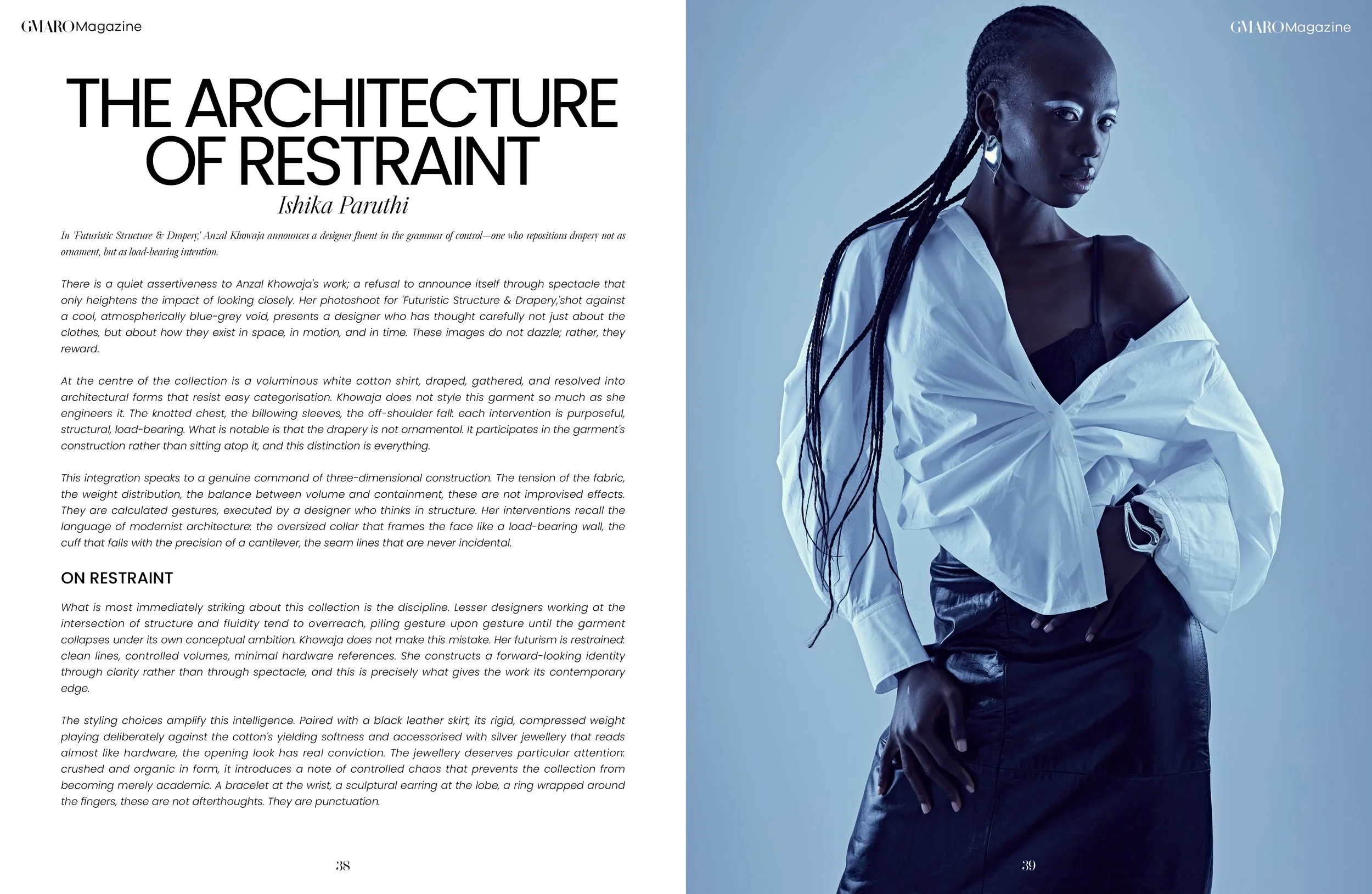
There is a quiet assertiveness to Anzal Khowaja's work; a refusal to announce itself through spectacle that only heightens the impact of looking closely. Her photoshoot for 'Futuristic Structure & Drapery,'shot against a cool, atmospherically blue-grey void, presents a designer who has thought carefully not just about the clothes, but about how they exist in space, in motion, and in time. These images do not dazzle; rather, they reward.
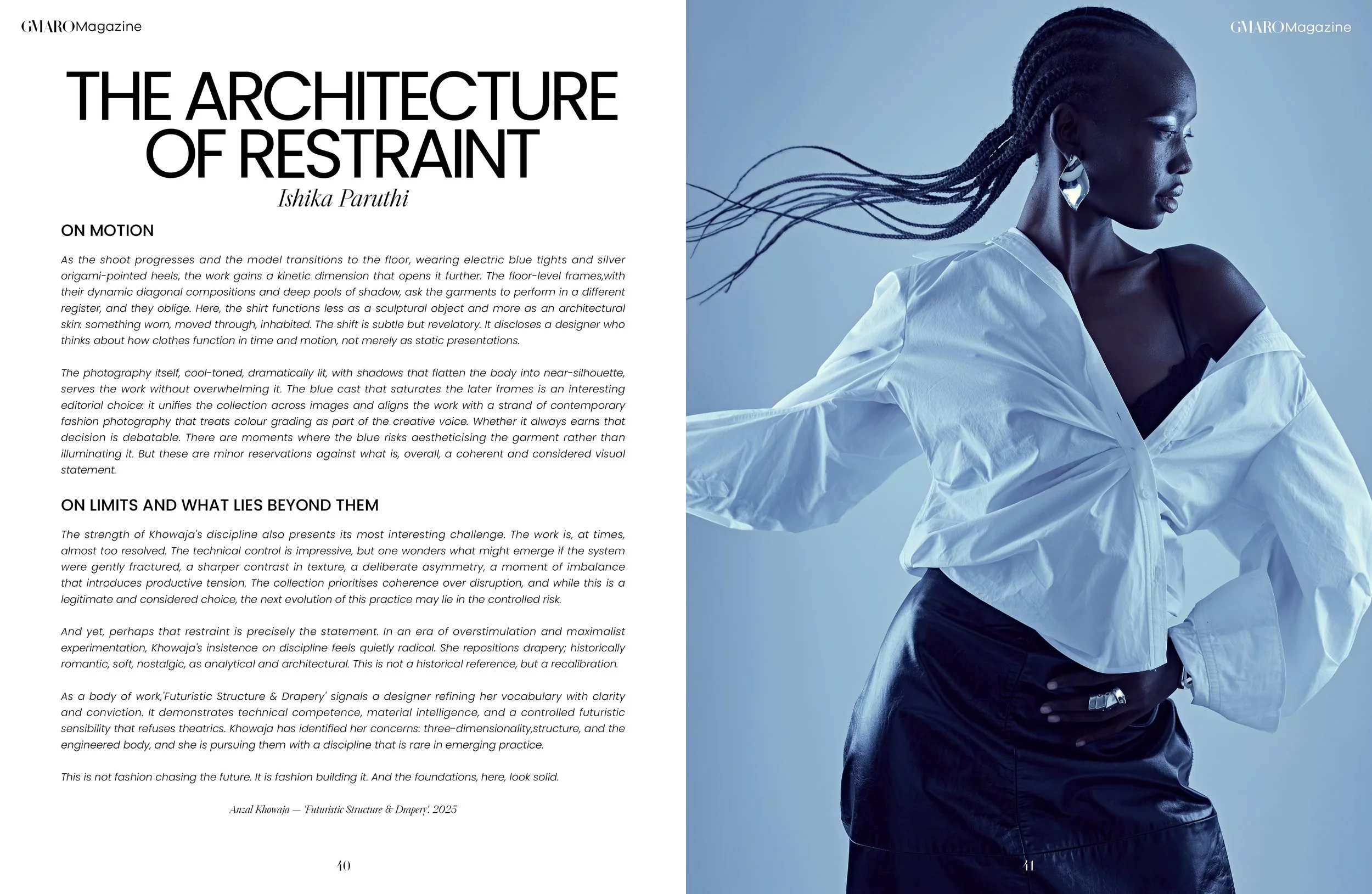
At the centre of the collection is a voluminous white cotton shirt, draped, gathered, and resolved into architectural forms that resist easy categorisation. Khowaja does not style this garment so much as she engineers it. The knotted chest, the billowing sleeves, the off-shoulder fall: each intervention is purposeful, structural, load-bearing. What is notable is that the drapery is not ornamental. It participates in the garment's construction rather than sitting atop it, and this distinction is everything.
This integration speaks to a genuine command of three-dimensional construction. The tension of the fabric, the weight distribution, the balance between volume and containment, these are not improvised effects. They are calculated gestures, executed by a designer who thinks in structure. Her interventions recall the language of modernist architecture: the oversized collar that frames the face like a load-bearing wall, the cuff that falls with the precision of a cantilever, the seam lines that are never incidental.
ON RESTRAINT
What is most immediately striking about this collection is the discipline. Lesser designers working at the intersection of structure and fluidity tend to overreach, piling gesture upon gesture until the garment collapses under its own conceptual ambition. Khowaja does not make this mistake. Her futurism is restrained: clean lines, controlled volumes, minimal hardware references. She constructs a forward-looking identity through clarity rather than through spectacle, and this is precisely what gives the work its contemporary edge.
The styling choices amplify this intelligence. Paired with a black leather skirt, its rigid, compressed weight playing deliberately against the cotton's yielding softness and accessorised with silver jewellery that reads almost like hardware, the opening look has real conviction. The jewellery deserves particular attention: crushed and organic in form, it introduces a note of controlled chaos that prevents the collection from becoming merely academic. A bracelet at the wrist, a sculptural earring at the lobe, a ring wrapped around the fingers, these are not afterthoughts. They are punctuation.
ON MOTION
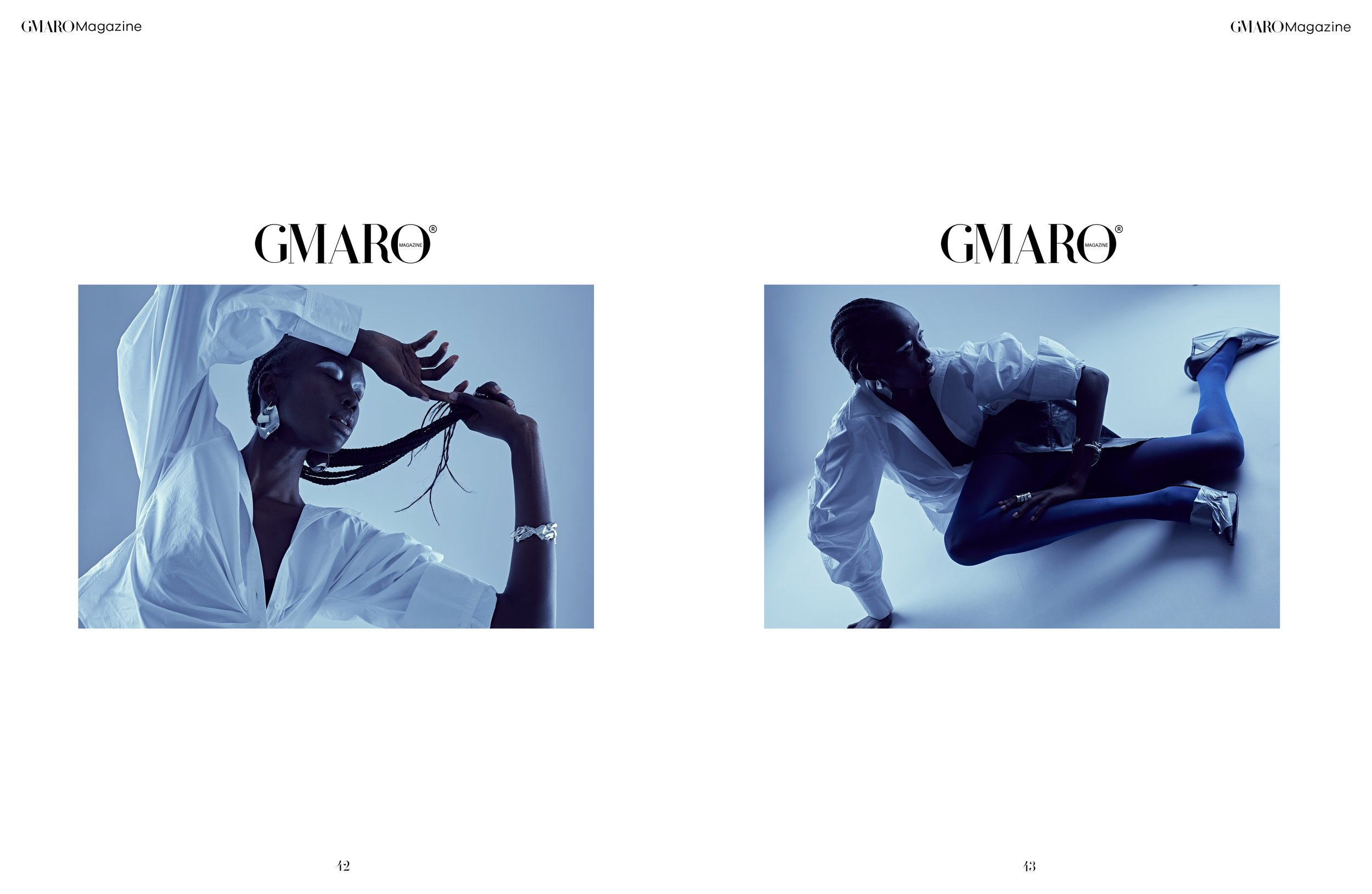
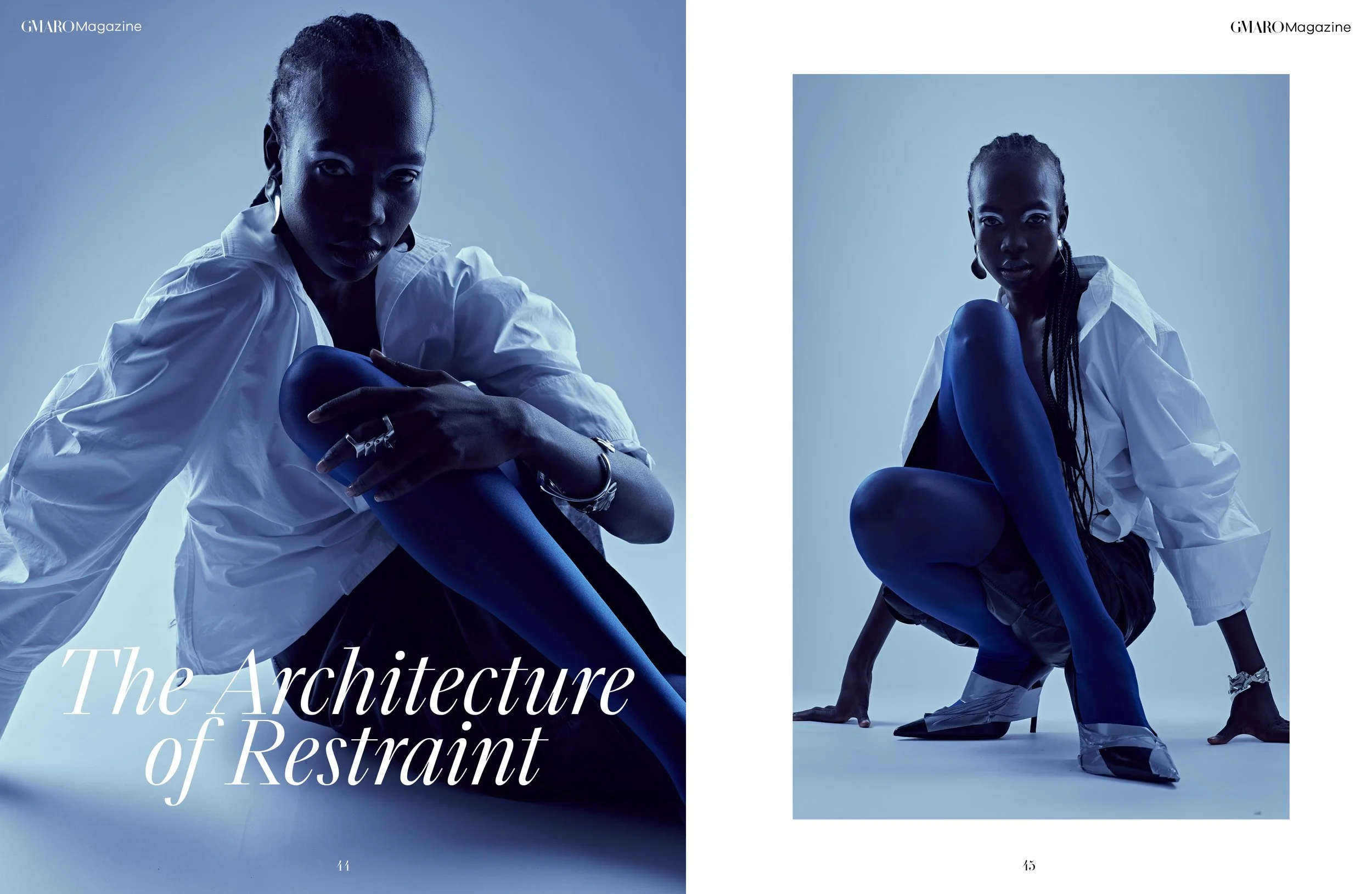
As the shoot progresses and the model transitions to the floor, wearing electric blue tights and silver origami-pointed heels, the work gains a kinetic dimension that opens it further. The floor-level frames,with their dynamic diagonal compositions and deep pools of shadow, ask the garments to perform in a different register, and they oblige. Here, the shirt functions less as a sculptural object and more as an architectural skin: something worn, moved through, inhabited. The shift is subtle but revelatory. It discloses a designer who thinks about how clothes function in time and motion, not merely as static presentations.
The photography itself, cool-toned, dramatically lit, with shadows that flatten the body into near-silhouette, serves the work without overwhelming it. The blue cast that saturates the later frames is an interesting editorial choice: it unifies the collection across images and aligns the work with a strand of contemporary fashion photography that treats colour grading as part of the creative voice. Whether it always earns that decision is debatable. There are moments where the blue risks aestheticising the garment rather than illuminating it. But these are minor reservations against what is, overall, a coherent and considered visual statement.
ON LIMITS AND WHAT LIES BEYOND THEM
The strength of Khowaja's discipline also presents its most interesting challenge. The work is, at times, almost too resolved. The technical control is impressive, but one wonders what might emerge if the system were gently fractured, a sharper contrast in texture, a deliberate asymmetry, a moment of imbalance that introduces productive tension. The collection prioritises coherence over disruption, and while this is a legitimate and considered choice, the next evolution of this practice may lie in the controlled risk.
And yet, perhaps that restraint is precisely the statement. In an era of overstimulation and maximalist experimentation, Khowaja's insistence on discipline feels quietly radical. She repositions drapery; historically romantic, soft, nostalgic, as analytical and architectural. This is not a historical reference, but a recalibration.
As a body of work,'Futuristic Structure & Drapery' signals a designer refining her vocabulary with clarity and conviction. It demonstrates technical competence, material intelligence, and a controlled futuristic sensibility that refuses theatrics. Khowaja has identified her concerns: three-dimensionality,structure, and the engineered body, and she is pursuing them with a discipline that is rare in emerging practice.
This is not fashion chasing the future. It is fashion building it. And the foundations, here, look solid.
Anzal Khowaja — 'Futuristic Structure & Drapery'. 2025