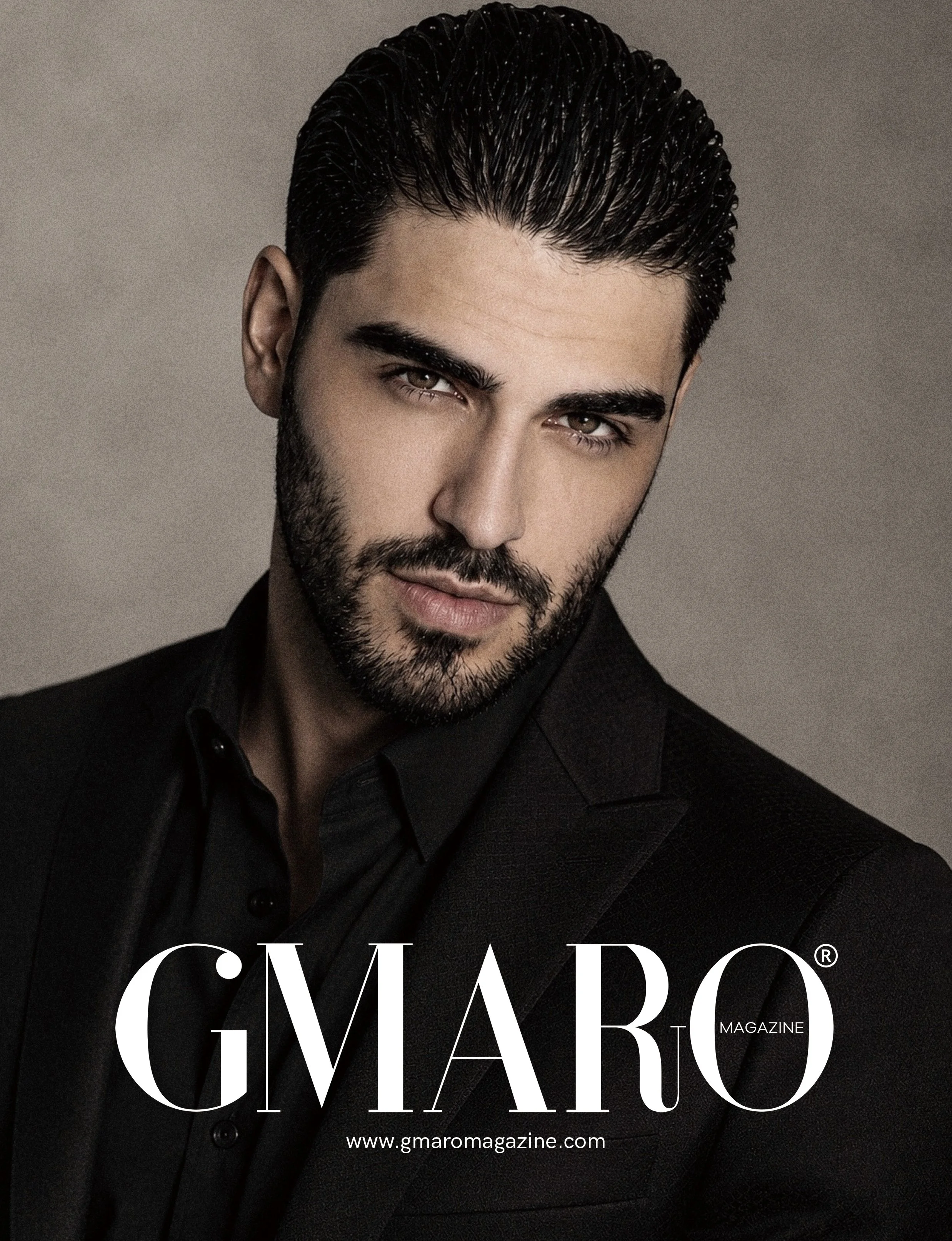
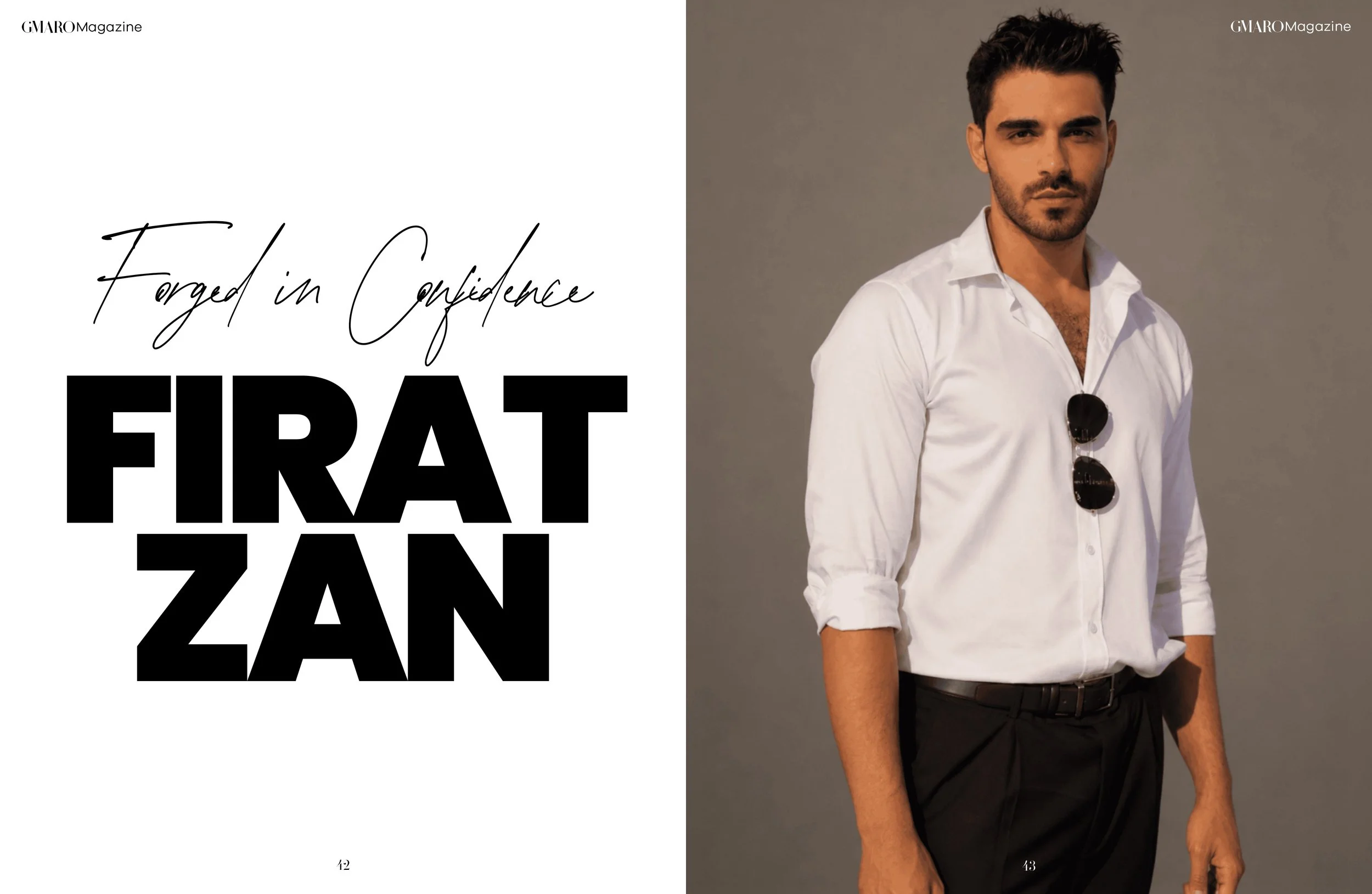
Introducing the cover of GMARO Magazine September 2026 Issue #15, featuring Firat Zan @ty_zan.
At 1.90 metres tall, with an athletic 97-kilogram physique, dark Mediterranean features and a naturally commanding presence, Fırat Zan is difficult to overlook. Yet behind the immediate visual impact lies a more considered approach to image-making — one increasingly defined by restraint, identity and intention.
With early modeling work rooted in fitness and physique, Zan has gradually developed a distinctly different visual language. Tailored suits, dark shirts, architectural settings, controlled lighting and understated expressions now shape an aesthetic that feels cinematic, masculine and deliberately composed.
For Zan, the evolution represents a shift from simply being photographed to understanding what makes an image memorable. Physicality remains part of his identity, but it no longer needs to dominate the frame. Instead, he is drawn to the quieter elements of photography: posture, atmosphere, expression and the tension created by what an image chooses not to reveal.
Dividing his time primarily between Antalya and Dubai, Zan also works in international property investment, giving him the independence to approach modeling with increasing selectivity. His focus today is on editorials, fashion projects and creative collaborations that contribute to a cohesive and recognizable visual identity.
As his work gains greater international visibility and his interest in acting continues to develop, Firat Zan speaks with GMARO about masculinity, fitness, fashion, charisma, the psychology of the camera and the value of creative restraint.
For him, beauty may attract the first glance — but presence is what makes someone look again.
Discover Firat Zan on the cover of GMARO Magazine September 2026 Issue #15.
——————————————
Cover Model: Firat Zan @ty_zan
FB: https://www.facebook.com/firatzanofficial/
Photographer: Isa Digi @isa.digi

Your image today feels very different from traditional fitness modeling. Was that evolution deliberate?
Very much so. When I was younger, my physique naturally dominated the images. I came from a strong fitness background, so the body was often the first thing people noticed and probably the first thing photographers wanted to emphasize.
But you cannot keep presenting exactly the same version of yourself forever. As I became older, my taste changed. Today I am much more interested in presence than simply displaying a physique. Sometimes a black shirt, a well-cut suit, controlled lighting and one expression can communicate much more than showing the entire body. I still consider the physique an important part of my image, but now I want it to support the photograph rather than become the entire photograph.
What does “presence” mean to you in modeling?
It is difficult to define because it is not one physical characteristic. Someone can have a beautiful face and an incredible body and still disappear in a photograph.
Then another person enters the frame, does almost nothing, and somehow your eyes immediately go toward them. That interests me. Presence comes partly from confidence, but also from restraint. You have to be comfortable enough in front of the camera that you are not desperately trying to prove something in every frame.
The camera notices tension. The strongest photographs often happen when you stop trying to look impressive and simply become comfortable occupying the space.

At 1.90 metres and 97 kilograms, you are considered handsome by both global standards and your fans. Your physique is clearly a major visual characteristic. How do you maintain it without allowing it to define you completely?
Fitness has been part of my life for so long that I no longer think about it purely
aesthetically. Training is part of my discipline.Of course, as a model, maintaining a strong physique gives me certain advantages. Clothes sit differently on the body, posture changes and your physical presence becomes stronger. But I am no longer interested in becoming bigger simply for the sake of being bigger. Proportion matters more to me now. I want to look athletic, masculine and powerful while still being able to wear fashion properly. There is a difference between building a body for bodybuilding and developing a physique that works with clothing, photography and film. That balance has become much more important to me.

Do you think your fitness background gave you an advantage as a model?
Definitely, although not only physically. Fitness teaches you repetition. You can repeat the same movement hundreds or thousands of times before something improves. Modeling has a similar element. People see the final photograph, but they don’t see the small adjustments behind it: changing the position of the shoulders, moving the chin slightly, controlling the eyes, understanding the light or repeating an expression until it becomes natural. Fitness also teaches patience. You understand that progress does not happen because you felt motivated for three days. Consistency matters more. I think that mentality has helped me throughout almost everything I have done.

Your photographs often have a darker, more cinematic masculine aesthetic. Is that something you naturally gravitate toward?
Yes. I have experimented with different styles, but I know what feels natural to me.
I prefer images that have a certain amount of mystery.Dark tailoring, black shirts, strong architecture, minimal interiors, controlled shadows —visually, those things fit my personality and physical characteristics very naturally. I don’t think every photograph needs to smile at you. Sometimes an image becomes more interesting when you cannot immediately understand what the person is thinking. I like that tension. There should be enough information to make somebody look at the photograph, but not so much information that there is nothing left to imagine.

Is that also why you rarely rely on exaggerated posing?
Exactly. Personally, I prefer controlled movement. A small change in posture or expression can completely transform an image. When somebody is physically large, especially at my height and build, you already occupy a lot of visual space.
You don’t always need to add more. Sometimes standing completely still is stronger. That restraint is something I have learned to appreciate more with experience.

Do you prefer studio photography or location shoots?
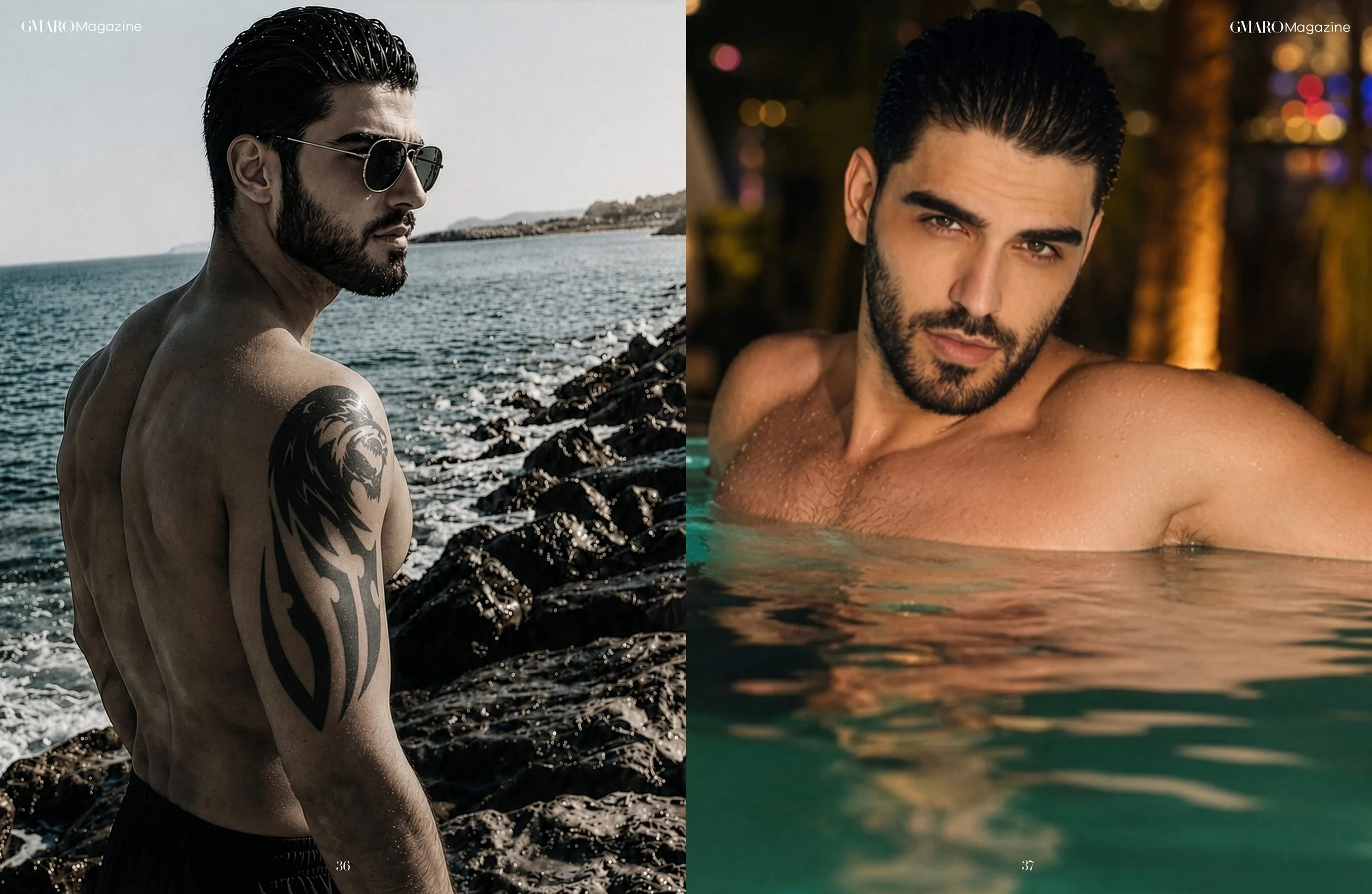
They challenge you in different ways. In a studio, there is nowhere to hide. The photographer controls the lighting and background, so the person becomes the main subject. Every expression and every position becomes more visible.I like that precision.But locations can create a story. Architecture, a hotel, a city at night, an empty street or an interesting interior can immediately give the photograph another dimension. My favorite shoots are probably the ones where the environment contributes to the character without overpowering the person. I like photographs that almost look as though they could be still frames from a film.
How involved are you in choosing the styling and creative direction of your shoots?
Increasingly involved. I have a very clear understanding now of what works for me and what doesn’t. That doesn’t mean I want to control the photographer. Collaboration is important because another creative person may see something in you that you don’t see yourself. But I usually have a concept in mind. Clothing, location, hairstyle, lighting and expression all have to belong to the same visual language. If one element is wrong, the entire image can suddenly feel disconnected. The strongest shoots happen when everyone understands the atmosphere we are trying to create.

Your wardrobe in editorials tends to be relatively minimal. Why?
Because simplicity exposes everything. If you wear ten different statement pieces, sometimes people remember the clothes before they remember the person. There is nothing wrong with that in a fashion campaign where the clothing is supposed to be the hero. But for personal editorials, I often prefer simplicity. A black suit.A fitted shirt. A clean silhouette.Then the photograph has to survive on posture, expression, lighting and presence. I find that much more interesting.

What does masculine style mean to you?
Confidence without excessive decoration. I appreciate beautiful clothing and luxury, but I prefer when quality is obvious without being announced. For me, masculine style is usually quite controlled. Strong tailoring, good proportions, quality materials and very few unnecessary elements. The same philosophy applies to personality.If someone constantly has to demonstrate power, wealth or confidence, I usually begin wondering whether they actually possess those things.
The most convincing confidence tends to be quieter.
You are frequently described as charismatic. Can charisma actually be photographed?
I think part of it can. Charisma is obviously much bigger than appearance because it also involves voice, intelligence, behavior and the way somebody interacts with people. But a photograph can capture certain elements of it. Comfort is one. Self-belief is another. The camera can often distinguish between somebody who is genuinely comfortable with themselves and somebody who is performing confidence. That is probably why some technically perfect photographs feel empty while an imperfect photograph can feel unforgettable. There is something happening behind the eyes.

Has age changed how you view modeling?
In a positive way. When you are younger, you usually want to prove everything immediately. You want to look bigger, more attractive, more impressive. Now I understand myself much better. I know what angles work. I know which clothes represent me. I understand my facial expressions better. Most importantly, I don’t feel that every photograph needs to impress everybody. That freedom makes the work stronger. I would rather have ten photographs that clearly represent who I am than one hundred photographs trying to satisfy every possible audience.

How important is international exposure to you?
Very important. Fashion is international by nature. One of the interesting things about modeling today is that a photograph created in Antalya, Dubai, Milan or New York can be seen globally almost immediately. I have always liked operating internationally. Different countries also respond differently to the same image. Something that feels very Mediterranean in one market might appear exotic somewhere else. That makes international editorial work particularly interesting because you begin understanding how your image translates across different cultures.
You have another career in property investment. Does financial independence affect the way you approach modeling?
Completely. It gives me the ability to say no. That is probably one of the biggest luxuries you can have in any creative industry. I don’t need to accept a project simply because somebody offered it to me. If an editorial doesn’t fit my image, I can decline it. If I don’t believe in the concept, I don’t have to participate. Ironically, that has made me take modeling more seriously rather than less seriously. Because when you remove financial desperation, the question becomes very simple: Do I genuinely want my name and image connected to this project? If the answer is yes, then I can give it my full attention.
What kind of modeling projects interest you most now?
Editorial work interests me a lot. I like images that have a concept behind them rather than simply documenting clothes or appearance. Menswear also feels very natural to me, particularly tailoring, luxury, lifestyle and more cinematic fashion concepts. I think my physical characteristics naturally work well with strong masculine styling. At the same time, I don’t want every shoot to repeat the same black suit and serious expression. The challenge now is expanding the visual range while keeping the identity recognizable. You should be able to evolve without becoming unrecognizable.
Do Antalya and Dubai influence your visual identity differently?
Absolutely. Antalya has a Mediterranean energy that is very natural to me. The sea, sunlight, stone, darker skin tones and relaxed atmosphere create one visual language. Dubai is completely different. It gives you contemporary architecture, luxury interiors, dramatic city environments and a much more international atmosphere. Visually, Dubai can feel almost cinematic without requiring much effort. I enjoy having access to both. One gives me something more organic and Mediterranean. The other gives me something modern and metropolitan.
Social media has changed modeling enormously. How do you see the relationship between being a model and having an online audience?
They are connected now, whether people like it or not. Years ago, a model could appear in a campaign and the public might know almost nothing about them personally. Today people can see your photographs, your lifestyle and your personality within seconds. That creates opportunities, but it also creates pressure. You can become obsessed with constantly producing content. I don’t want modeling to become simply an endless search for engagement. A strong editorial photograph should still have value even if you remove the number of likes underneath it. That distinction is important to me.
Do compliments about your appearance still affect you?
Of course. Anybody who says they feel absolutely nothing when somebody compliments them is probably not being completely honest. It is pleasant. But after you receive enough attention, appearance becomes less interesting as a subject. Being called handsome is flattering. Being called memorable or charismatic means more to me. Appearance can make somebody look once. Something else has to make them look again.
Acting has recently become another area of interest for you. Does modeling prepare you for that transition?
Visually, yes. Modeling teaches you awareness of the camera, lighting, movement and expression. You learn how very small physical changes communicate different emotions. That is useful. But acting is obviously a much deeper craft. A photograph only has to capture one convincing fraction of a second. In acting, you have to sustain a character. You have to listen, react, speak and make the audience believe something over time. So I respect the difference. My modeling experience may give me certain advantages in front of the camera, but I don’t believe appearance or modeling experience automatically makes someone an actor. I want to learn that craft properly.
What do you think separates an attractive man from a strong male model?
Awareness. Being attractive in everyday life doesn’t automatically mean you understand the camera. Modeling requires you to understand your body from the outside. Where are your shoulders? What is your jaw doing? Where is the light? What happens to the clothing when you move? What emotion is the photographer trying to capture? A model has to become visually self-aware without becoming self-conscious. That sounds contradictory, but I think it is one of the most important distinctions.
Do you think your physical appearance sometimes creates limitations as well as advantages?
Certainly. A distinctive appearance makes certain roles or concepts very easy to imagine. At the same time, people may immediately place you into a category. Because I am tall, athletic and have a serious expression, the obvious direction is always the powerful masculine character. That can be useful, but I don’t want it to become a cage. The interesting part is showing different emotions while still keeping that physical identity. Sometimes the most memorable image is the one that contradicts what people expected from you.
What kind of characters do you imagine yourself playing?
Probably characters with restraint. A businessman. An antihero. Someone powerful but psychologically complicated. Maybe somebody you cannot immediately decide whether to trust. Those characters naturally interest me because so much can happen beneath the surface. I find a person who remains calm in a tense situation much more interesting than somebody who is constantly demonstrating aggression. Restrained intensity fits my personality and visual identity much better.
Where do you want to take your modeling career from here?
I want quality rather than simply quantity. More international editorials. Strong fashion photography. Interesting collaborations. Potentially campaigns that fit my image. And I want the body of work to become increasingly recognizable. That is important to me. When somebody sees a photograph without immediately seeing my name, I would eventually like there to be something about the atmosphere, styling or presence that makes them think it could be me. Developing that kind of visual identity takes time. That challenge excites me.
What would you like photographers and creative directors to understand about you before working with you?
That I take the creative process seriously. I am not interested in simply arriving, standing in front of the camera and leaving. I want to understand the idea. What are we trying to communicate? Who is the character? What should someone feel when they see the image? I also enjoy collaboration. A photographer may notice an angle, expression or side of my personality that I have never considered. That is one of the reasons I continue modeling. Every strong creative collaboration teaches you something about your own image.
Finally, when people see a photograph of Fırat Zan, what do you want them to feel?
Curiosity. I don’t necessarily want them to understand everything immediately. The photographs I personally remember usually leave me with a question. Who is this person? What is he thinking? What happened before this frame? What happens after it? For me, that is much more powerful than simply creating a technically beautiful image. Beauty catches attention. Presence holds it. And if an image can make somebody stop for a few seconds longer than they intended, then I think we created something worthwhile.